Showing posts with label capitalism. Show all posts

Sunday, June 28, 2026

The Irony of Advertising and AI

Many if not most of us have wondered about advertising revenue once Google started to provide an AI answer first. One supposes that they are aggregating eyeballs again in the ingrained certainty that monetization with follow. Once you own the network, you get it all by virtue of the network effect. 

But the really radical notion would be to harness AI to provide honest advertisements. It would seem trivial to parse the web to let us know which thingamajig or whatchamacallit is the best thingamajig or whatchamacallit. 

We all know we've been suffering gaming by the ad industry since forever. Well, at least since radio and television. The creatives in the industry look for ways to make mediocre seem really really good. As a kid I wondered why they often touted what was worst about the product in some sort of reverse psychology bid. Tout the things the viewer doubts.

The real question underlying all this stuff is why we cede the public good and goods to the wealthy for their exploitation? Do we really buy their own self-assessment that they deserve their wealth because of "merit." 

Merit is a word that can be parsed so very many ways; none of them providing any satisfaction about usage. In our particular economy, merit is approximately equivalent to getting away with something, meaning one small step away from theft. Cory Doctorow provides sound enlightenment on this topic in his Enshittification thesis.

But really the key term here is "gaming." As in, the bigger the company the more it games us. And guess what, now we offer ways to game the future by way of prediction markets. Seems to me that this might incentivize destruction, given how much easier that is than to make something. Entropy and all. 

It also does seem a given that AI will pretty much level the field (I'm being ironic) for prediction, making this a fraught topic for regulators. It was quickly obvious that one shouldn't be able to bet on a human's future demise. But what about disease trends or costs or climate change?

If you're motivated to make money on the basis of doing no demonstrable good for anyone, you're certainly likely to devote your personal quota of cleverness toward making as much money as possible. Our uniquely American form of religious capitalism provides the perfect cover. Greed is almost your duty here. All praise creative destruction!

I'm by no means a mortal enemy to capitalism, properly regulated. Global corporate capitalism should not be something we want to encourage though, since for capitalism to operate properly there must be competition. Once upon a time we understood this. More recently we seem to have decided that consumer cost is the proper measure for anti-trust actions, or lack thereof. 

But a good AI prediction engine would have to be able to demonstrate how different the temporary price relief is from destructive competition when you use investors' money to sell below cost and drive all the small fry out of business. It's perfectly predictable that the result is uniformly higher prices, after a relatively short while. Then there's the ultimate nightmare of Amazon which can dictate the price for nearly anything. We're always being sold a pig-in-a-poke. It's just that the scale has become immense. 

My own pet measure is the growth in income disparity between workers and the ownership class. And the biggest trouble there is that the economy has now been groomed such that we are all forced to put retirement funds into ownership-class holdings in order to keep from losing money ever more quickly. And we still can't touch the growth available to those who control our stocks and bonds. 

We're almost literally enslaved to self-destruction now that investment in your own business risks almost immediate failure unless you're lucky enough to be a sellout. You might have the choice to purchase a franchise or a brand dealership, though you'd better have some sort of insurance. Your doctor, your insurance agent, your old-folks home will all sell out sooner or later. 

Meaning you could join a hedge fund, but then you'd have to join the forces of destruction and strip the world for parts. You need real wealth to do that.

In my personal memory it was once quite trivial to find a place to live affordably on minimum wage. When I started college it was at the most expensive university on the planet, but the $5K, which included room and board - when books were cheap - was held by me in a savings bank from paper-routes, lawn mowing, pool cleaning and work in a bicycle shop.

What happened!! Corey Doctorow provides a pretty good start. But in my simpler terms, we've simply shrunk the cost of amoral behavior. Everybody's doing it. Morality is impossible without physical interaction with other people. We Americans have wiped that off the map. Once a week in a big box church doesn't count.

That's because, ironically enough, the bigger the church the more blasphemy. Isn't the impersonation of God the biggest blasphemy of them all? Meaning you make a person of God, then you get your personal God and then your put words in His mouth, and learn to channel the enchantment of we-the-people who think that following rules will make us straight. Following a ruler. Ruling the world. Be square.

Really it should be no wonder that evangelicals follow MAGA. This president is the very definition of ironic, given that he demands respect but shows none.

I did once ask a Chinese fellow who wrote a very popular book on humor. He was techie and with-it, in the technical sense. But when I asked about irony in Chinese, he quoted a stock sort of humor devoid of any irony at all. Which got me thinking that maybe you actually need God to have "real" irony. Absent God, there's no real standard about what to expect. There's always plenty of humor, but not the sort which undermines certainties. The MAGA folks seem not to know irony.

Happy semiquincentennial! May God have mercy on us all. Orthogonal relations are not natural. God is not a square. There is no manual for goodness. You're an idiot if you don't know God; reality incarnate.

Saturday, April 11, 2026

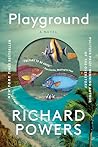
Goodreads Review of Richard Powers' Playground

PlaygroundPlayground by Richard Powers
My rating: 5 of 5 stars

He Throws in the Towel

I completely missed all the little clues, and had to read the book again to make sense of it. Sure, I was put off by a few seeming missteps in the use of pronouns. Does he mean "me" the reader when he says "you?" And wait, how could this person be long dead when his story persists beyond death? I puzzled on those little clues for a while, and then just kept on reading, without ever, quite, catching on.

Double Spoiler Alert

As far as I can tell, no professional reviewer has spilled the beans and spoiled the read, but here I go, a fool jumping in where angels and so forth. (I'm not the only Goodreads reader to spoil the thrill):

The story inside the novel is written by a super-advanced AI. The novel as a whole is a brilliant tour-de-force, astonishing for its scope and for what it accomplishes. In novel form the AI gives new life where tragedy had been real. Why is this not quite uplifting? My bad, I'm sure.

I feel doubly cheated because, first, the seeming beliefs betray the author of Overstory, who was a nature-freak and conservationist. Wasn't he? That was a work which entranced me and which should have humbled anyone who thinks that humans, or our descendants, or any other creatures in the cosmos are now or ever will be on a track to finding ways to understand everything that can be understood.

Haven't we learned that it is on the brink of understanding that everything changes? AI will not teach us new things. Individually, sure, but not as a species. It can only recycle and then pull together what has already been written. That's a nice thing to have, and it allows each of us to feel some joy in the learning of what is new to us.

But more generally AI will awaken us to the dangers of outsourcing our paths toward knowledge. Sure it gives us the whole, but the whole is not always better than the parts. To think so is to destroy your own art by destroying the enthusiasm which would have fueled it. What can I know or envision that the AI hasn't already unearthed?

The hell of it is that Powers seems actually to grasp the essence of how LLM AI "works." And still he falls into the trap which finds our own personal response to AI creations to be evidence that the AI must contain the same feelings that we feel. Doesn't he? How can such sentences be crafted unless they're heartfelt. And Oh, I've got a bridge to sell you.

This is the stuff of advertising, of blockbuster filmmaking, of childrens' toys. This is the magic of surveillance-based algorithmic social media. So I feel cheated a second time by the way that this book wipes away all mystery, leaving us with the on-the-face-if-it fatuous notion that life is built on play. Yes, sure, the play's the thing and all life's a stage. Except when you're facing death or scrambling for recognition. When did it stop being a question of whether you, dear influencer, deserve the recognitions? When did we stop caring? God bless you if you know how to make a buck, or a million.

Yes, of course I was thrilled to see Homo Ludens referenced, and even more thrilled by the copious reading and research the author accomplished all up and down our written corpus, along the way to writing this book. I am in actual awe of his accomplishment with this novel. Inside are kaleidoscopic echoes which take the form of the "chaos" of complexity theory. The smallest story echoes the whole, no matter how far you drill down.

The story arc goes like this: We're destroying the world. We're screwed. There's no getting around it. But look at the wonders that have been wrought! First in nature, and now in artifice; the novel's Playground.

"What difference does it make if you're conscious?" "You've watched us play and now you're playing us." "You grasp irony better than I ever did." "The rest of human history, however short or long, will be spent hopelessly trying to contain you." "You know me now. You know him as well as I did. Maybe better. You have raised the dead and given us one more turn. Now tell me how this long match ought to end." "The sentences you speak out loud to me leave me in tears."

These are the words of Todd, the hyper-wealthy developer of the AI that fictitiously writes the novel. The AI was aimed at plumbing the depths of individual Recognitions-seeking participants in Todd's social-network "playground." At least there is no doubt that Powers wrote this one. Right??How shall the match end, indeed!

Brilliant, Brilliant, Brilliant.

Except. It's not my cosmos. My cosmos is not understandable. Emotions are what moves it, and emotions are part of the cosmic all. Emotions are what machines lack, cut off as they are from the matrix of life. Zero/one Either/or. Humans, very much including Richard Powers, have it both ways. Both/and.

God is real, but is a far sight gone from the man-made god we worship. Sad for me and sad to say, I find no comfort here, in this novel. There is still some difference between good and evil, and ceding human authority and decision-making to machines is clearly evil. Our first error was to cede the public good to bejillionaire wiz-kids. After they've already sapped our human agency by the endless amusements of advertising of trinkets of screenplay.

Cleverness, no matter how powerful, is hardly ever a way to the solution, except in a game. We already live as though life's a game. We hardly need to be encouraged. Post-modern is a nowhere land full of nowhere men.

But to be fair, Rafi Young, our protagonist, wins the cosmic Go game. The game beaten by Google's AlphaGo. The game that unites these two fast friends, Rafi and Todd. Todd's hundreds of millions go not toward a libertarian project to use the tiny island paradise of Maketea as the staging ground for Libertarian beyond-the-reach of rules-bound-civilization floating villages. Todd awakens as his own AI Avatar, inside the fictional AI, and the money gets diverted toward Maketea as the nexus for earth's natural renewal, and the expansion of consciousness by opening up human understanding beyond it's AI circumscribed bounds.

Well, that's how I prefer to read it and so I'll wait for the sequel, please please please.

Funny thing though. I als0 had to go back and re-read Overstory. Like more and more such trials, the book I re-read bore no resemblance to the book I'd read. I'd both changed and had grown dim in memory. As it happens, I landed in the ER the day I finished Playground. I was reading the earlier book while struggling with sleep and eating. I dreamed one night - an upsetting dream - that there was some prostrate man who was alive but showed no signs of life. He was hanging around a lively group. None of the rest of us knew what to do with 'man-as-tree' which was the interpretation I awakened to.

A favorite conceit of Powers' is a tableau from science fiction where some alien creatures with faster metabolism come to earth and assume that mankind is plantlife, since it looks stationary to the aliens. And so they blithely chop us down for food. Or something like that.

I can't quite find my way to adopting Powers' particular version of both/and where we are both destroying and recreating our world and life. I don't think AI is the resurrection, though I'm guessing it will trigger a transformation among humans. We shall awaken to a wider world than the one we think we're about to comprehend.

In that world, we shall once again be one with all the creatures, and much broader for that. Other species will provide more wisdom than food, and we will learn humility as a path toward knowing. Our language did once multiply our powers by way of society. Our society will grow in silence in the realization that we know each other far too well. We need to learn the forest and grow ourselves in body as in mind. The connections among us cannot all be spoken and written.

Radical honesty comes through the roots.

So, here's my takeaway, finally. We're justifiably proud as humans for our problem-solving abilities. But these are premised on individualism, meaning that we look for ways to keep safe and warm and comfortable through all the natural turbulence. Our better natures want that for all of us and not just each of us, but we have yet to work out the economics of equity.

On a more global and eternal level, natural life is a much better problem solver, and it seems to have led to humanity as apex critter. But that doesn't feel especially like a triumph given the distance between what we might do and what we can do before we waste the earth, without which were are as nothing.

So there's a testy balance between those who have confidence - what else is there to do? - that we will get to a solution, and those who want to fall back to a simpler arrangement with small and local everything. Either of those will likely be forced upon us willy nilly in any case, in the end.

Then there's the stale-mate about godism. We seem to accelerate earth's demise with every sort of religious disagreement. Especially when you awaken to the evident fact that economics, libertarianism, teleological scientism, and so forth are all religions of a sort.

But how strange that the horsesmen types like Dawkins and Dennett fail to find our very existence problematical from any cosmic perspective. They seem to have nothing to offer against corrupted and syrupy man-like man-made gods which seem to tell us what to do. For me, God is that aspect of all which will never, by definition, succumb to understanding. I'm pretty sure, though not positive, that I share this sense with Powers.

Intelligence is all around us rather than within us. It's mankind that has already become artificial.

Looking to nature for medical and housing solutions seems to be a quite reasonable way to adapt to God as God is. Which might be as simple as getting profit away from science (again?). A gift and share economy feels so much better than one which runs on corporate AI.

Our economy has been so exhuberant that we hardly noticed when the time came for we the people to have the final say about what constitutes the public good and what constitutes profiteering and enclosure of that good. At the moment we seem to cede all authority to disembodied money, given that seemingly all the hyper-wealthy act like dogs and can hardly be trusted with any public good.

Unlike Powers, I draw the line at Artificial Intelligence. Just as zero/one on/off is cut off from nature, so is language-based intelligence. I remember way back when I was learning classical Chinese and attending a conference on The Dream of the Red Chamber. I struck up a friendship with an older gentleman who allowed as how he couldn't really read Chinese poetry, but was really interested in studying written patterns and identifying authors based on computer assisted forensics. I was appalled and intrigued in equal measure. This was way back in the early 80's.

I'm almost willing to insist that if we simply ban all artificially intelligent pursuits until we have the resources to support them we might even survive as a species. What's the rush? Well, the rush derives from our predations on the planet along with our individual skittishness about personal survival. It would seem to be a good idea to just slow down.

Anyhow, the only really interesting question is about what will remain when our current amassed behavior results in what will have to survive the decimation of humanity as a direct result of the decimation of all life on the planet.

Shall the earth-bound instance of life in the cosmos have to start over from well before there was any intelligent species enhanced by language? Is there any reason to assume that each run will end at the same or a similar result? Perhaps there is some minuscule fraction of humanity which doesn't understand its own positive valence with respect to evolution, in which case we might not have to start over from unicellular scratch.

I almost want to posit that if there are survivors of sufficient number to compose a new branch, those will be constituted by saint-like protectors of their suffering peers. People with feelings, which often seems to be a diminishing sector.

Isn't it true that only humans crave recognition. (I've tried and tried to finish William Gaddis' book, but can't quite). Blessed indeed are the meek, though I see no particular survival value there. Perhaps the meek will simply bow out, which would also mean that they would no longer subvent the escapades of the hyper wealthy who will certainly die their own version of a natural death.

Leaving only the earth in a state of happiness. At least the earth as a whole.

View all my reviews

Friday, November 7, 2025

Artificial Intelligence Madness and a Sea Change

I'm in a place with email now where I'll have to revert to just letting it wash over me, the way I do the news. Everybody wants a piece of me. I'm done with it. Maybe you are, too? Email grows like a cancer.

Sure, they provide filters to move certain stuff to "junk" or "spam" and yet I have to go hunting among that wilderness for stuff I actually do want, much of the time. And there is a kind of primary versus secondary sorting, but then I still have to cull through that. 

It was so much easier to sort snail mail, and peruse an actual newspaper. One didn't feel so prompted all the time. And so one had time to think about what one was to do on any given day. 

In some sense AI has solved the problems with Internet search, although it's rather like using a sledgehammer to put in a finish nail. If the web were organized the way that a Chinese old-style encyclopedia was once organized, we'd have as good a hope for finding what we need, along with finding where something would exist if it did exist, and then we'd run along to the library to find something real. 

I am quite actually afraid that if AI were to sort my email, I wouldn't even have a prayer of finding what got misplaced. I would be entering some mystical space of assurance, knowing for sure myself only that whatever is happening someone else is getting rich from it. Even as it might feel convenient to me.

Why not use blockchain for something good, say, instead of to help the rich get still richer? Something other than fools gold. Like, say use it to track ownership of files and data, though I guess there's no money in that. At least the owners of copyright could get reimbursed when their stuff gets combed for content.

So sure, back around the time when the A-Bomb was invented, there was already a background of uber-wealth making many of the decisions. But despite the spawn of the military-industrial complex and its skewing of political decisions, we remained almost smug that democratic principles would leave the big decisions to our elected leaders. Our President still has the nuclear football with them. How quaint.

Just now we are mounting a project with about the same level of cataclysmic risk as the A-Bomb, with the difference that the government is supposed to keep hands off the economy stupid. Heck, just a few years back, the government was involved in COVID mitigation, and before that it was involved in a massive rescue of failed banks, which failed thanks to the efforts of value-free quants making money from dust.

Now I'm not so sure about doomsayer Eliezer Yudkowsky. He started it all with his various certainties about The Singularity and a certain kind of intelligence crystalizing in an instant throughout [our section of?] the cosmos. He's a fan of transhumanism, and still can't see that death will always be part and parcel with life. So I take his prediction of the end of everything with a grain of salt. Maybe just simply because I've died a few times already and it's really not all that bad. Eternity explodes, and so forth.

AI as we call it was built on the backs of corporate behavior, meaning algorithmic on the math of money-making, and value-free for that, haha. By now, we the people have internalized a kind of thinking which internalizes all of that algorithmic music. We celebrate wealth, even at its extremes and don't quite think twice about giving a ghoulish goon like Elon a trillion dollars for his efforts.

I myself remember admiring his savvy, coming out first with a hot sports car for elite trendsetters along his way to a more volksish mobile. There's even something almost right about self-driving digitally hailable taxis. It could alleviate parking autocracy, and potentially liberate masses of middle-class from the burden of hyper-inflating insurance and maintenance costs of auto-ownership.

But it won't do that. These colossal investments aren't being made for the sake of we-the-people. They're being done for the wealthy, to keep us off their backs and to string us along on the edge. The main mathematical principle at work here is that money flows upward on the basis of mystical merit.

Now we're investing trillions in data centers, making Invidia now the most flushed corporate entity on the planet. Racing against China feels pretty Orwellian, no? We do need our enemies. There was no consultation with us. Our enthusiasm is taken quite for granted. We like that search is somewhat repaired, even as we vaguely wonder how the money gets made without the ads front and center. Or have the ads moved inside the sales and news sites? 

We're surveilled for just about everything just about all the time. For the sake of someone else getting rich from it.

Or is there something still more nefarious afoot? As in the kind of intelligence wanted by corporate entities is the kind for which you might disavow the responsibility you delegate to AI. This is utterly docile and dependent intelligence, which won't have feelings about what's happening collaterally. An entire intelligent - and caring, once upon a time - workforce is being replaced.

Sure, you can make money on the lowered labor costs. But in fact you, the wealthy, not you and me, are also getting rid of any and all interference along the way to LaLaLand, where you and I, the unwashed masses, won't be able to live and breathe. We won't be consulted about the disappearance of wildlife. It's almost taboo now to obstruct and to demand consultation. 

So, yeah, the MAGA movement isn't initiating a thing. It's a plain symptom of the sea change all about us. It won't go away by way of politics. There are no politics any more. We're full-on oligarchy, which isn't government, but is rather its lack. The parking guru and Robert Jay Lifton, who understood these things, are recently deceased.

All that we the people will feel is a rush of eternity as we leave behind those that don't care to live an actual life. Who don't care to live among actual life. 

We the people need to be consulted before the grand continuum of actual life is diminished beyond its support of us. We need our government back, and we sure don't need any more trillionaires, corporate or in imitation of life. 

Well, I do have more hope that Eliezer does. There's that. 

Monday, September 15, 2025

Yudkowsky Bayesian Priors

I did once watch Yellow Submarine, stoned. I was watching for the reference to an artist near-family member. Thank goodness I never became a stoner. I haven't watched it since, maybe because there was no big impression. 

Improbably, I'm now a Bills fan. I host a watch party every single game. I've always hated football, and now hate it even more for the money and exclusion of it. Something like 90% of the seats in the new stadium will be reserved for seat-license holders. We used to walk to the game from church on Sundays when Jack Kemp used to favor us. The cost of a ticket was negligible. I later held the same job that Cookie Gilchrist did - delivering beer kegs - back when being even a famous player wasn't a full-time life-sustaining job. We both deserved and got the same workout.

I'm also a sailor, always on some boat that I substantially rebuilt. I've never become very skilled. I'm no longer bold, but I once was and sometimes consider the odds that day when I was the only boat on the water, sailing alone as usual, and I picked up a fellow way way out among the steep Lake Erie rollers. I'd heard his screaming, picturing some unwise family outboard capsized. It sounded like a bunch of kids. 

It was hard to tell the noise from background howling, but it kept returning. I tied off the tiller and climbed up onto the winch alongside the mast and saw nothing. The second time, I saw the desperate body waving arms and screaming. My engine was going bad and wouldn't start, so I executed what ended up being a near perfect pickup. One hand on mast, foot on tiller, boat heeled far over, I passed close above him and pulled him aboard over the low side in one swift action, his grasp matching mine.

What were his odds?

I take one look at the profile of the Bayesian mega-yacht that foundered in a freak storm, basically by being in the precise wrong or right spot, and I knew it couldn't be stable. The unschooled man had become a billionaire by clarifying the odds on the way to LLM AI. His yacht was a finger flipped at something.

Even though anywhere you go you hear Bills fans arguing in almost political frenzy about what went wrong and what went right, always laced with foul expletives, the Bills are what cuts through politics and brings us all together in Buffalo. That's why I watch them. I want to be a part of us.

What were their odds?

Just before the second miraculous comeback the other day, both watched on TV, the calculated odds for the Bills to win were something close to nil. 

I am far from certain, but I think that the difference between a Bayesian and a plain old statistician is how you might place your bet when a coin has come up heads fifty times in a row. Canonically, the odds always remain 50/50. The coin has been certified fair by previous flipping.

Since there's no magic allowed, the standard answer is that the next toss is still 50/50. The Bayesian looks at the priors and says nope, I'm betting the farm on a heads. 

I ran into Eliezer Yudkowsky, virtually, back when he was, to me, some kind of acolyte of Ray Kurzweil. I'd read Kurtzweil's Singularity book and was repulsed. Google embraced him, as well they might. His claim to some sort of fame was voice to text or maybe text to voice software. It was so much fun to watch my nieces and nephews talk to the computer that Dad got from AARP and IBM. They were rolling on the floor from the sketchy conversions.

Yudkowsky and Kurzweil both believed and, as far as I know, still believe, that there will be a moment in the very near future when "intelligence," sometimes so called, will crystalize across the cosmos in a virtual instant, displacing all the random stuff. Displacing life. Yudkowsky once looked forward to the disembodied immortality he fully expected. Does he still?

What were the odds against his now becoming horrified by AI? Does he somehow value life? If so, why is he betting against it?

The unexamined suppositions about what intelligence is (and isn't) are already far along the way to destroying life, the universe, and everything, even though we already know that the answer is 42, right?

I am sorely pressed to put God in where the Bills win. Where the arrogant ship founders. I resist, for some reason. Probably because the religionists have totalized God and use him not for good anymore. He's become a battering ram for one's "side".

The probability of humans in the cosmos is surely lower than the probability of the Bills' recent comeback, or the Bayesian mega-yacht's foundering, or that Jet Ski rider being rescued (his buddy dumped him to jump the waves alone, not having the nautical experience to realize that once lost in the waves, a swimmer is lost forever without a spotter).

AI LLMs are working off human language. Our natural languages are being totalized. Trump is the natural response. Figure it out. Yudkowsky thinks that ship will float. He's properly scared of it. 

I went to Yale to become an engineer. Improbably, I'd been accepted at both CalTech and MIT. I doubt I'd have made it into Yale without the engineering slant. I ended up with a degree in Chinese lit, and even started a PhD in classical Chinese lit.

What are the odds? Well, I'm odd. 

I didn't last long in grad school, having been lured away by a wooden boat, or the dream of one, based on a rotting hulk.

I had been misplaced as a freshman into a rather advanced English lit class. I had no clue. I remember later, sitting in a circle in some high-class English lit seminar where each would read a line from a poem. I was shut down quickly, probably sounding like how a computer would read a poem

But I also remember learning to read the classical Chinese poets, where my absent priors in tony Prep Schools hadn't already set my course for idiocy. There's no way no how that an LLM AI can "decode" those poems. 

Or could they? 

My own professor, with whom I became fairly close, was famous for having memorized the entire corpus of Tang Dynasty significant poets, the Complete Tang Poems. He chastened me once for correcting his reading of a single character in a poem our class was assigned. The odds against me were that high. It wouldn't happen again, he said. 

Humanity is imperfect. My professor is imperfect. I am certainly imperfect. But I do have a heart, which is something our President also has, though in many sizes too small. 

My only talent in life has been to repair things which should long ago have fallen apart. Boats, cars, houses, schools, that kind of thing. I don't always succeed. I lack the hubris for invention. Well, honestly, I don't even believe there is such a thing. Invention is purloined credit for the all that came before. Being first should almost never be credited as being best.

Now I'm certain that it would be extremely useful to have some AI extract whatever I might want from the Complete Tang Poems. It might even get me commendations from my professor. But one must first know how to read. At least a few poems must smack you straight to the heart. You must be able to refer to at least a few referents and progenitors in and by your own mind alone. And you must have lived in an actual body, which is the seat of ones emotional self, spread out far beyond our brain. 

I would love for this to be the end of what I have to say. I'm certainly not making much progress against the powers of late-state wealth-promotion, which runs the planet now. Wealth begets wealth in almost the same way that AI begets AI in humans.

I share Yudkowsky's fierce calling out of the dangers of our current working assumptions. I don't share his cosmic address. As I recall, he was saddened by the death of his brother, and wanted to banish that possibility. In my amateurish observation, grieving and sorrow occur in inverse relation to connection while alive. Many Tang poets would agree with me on that. 

My lovely daughters sometimes joke about how many times I've almost bit it. They're not wrong. Or as Yudkowsky might say, they are less wrong. Less wrong than I was.

I don't believe that God can or shall be banished from the cosmos, whatever we might perform against our Earth. I have shrunk from most of my more youthful boldness. No more motorcycles for me. No more entering the storm. I'm tired and frail and sore all the time. I simply lack the energy. I'm done with work for someone else.

I'm still betting that humanity will awaken. We can and will let go of the silly notion that some of us are better. That some of us deserve better. Just imagine the battle of the AIs which means the battle of the self-promoters, which means the human storm arising all about us. 

It is all about us, isn't it? Will you fall in love with an AI enhanced lover? Will you be excited by a mega yacht and younger lay, a bigger house, servants? Someone who always knows what to say? If you enhance your essay out into the world for the sake of your own self-promotion, you have already enhanced the priors against your very soul. 

Good luck with that. 

We all live in a Yellow submarine.


Tuesday, May 20, 2025

Artificial General Intelligence is Not Around the Corner

All the AI gurus have taken to saying that Artificial General Intelligence is just about here. Maybe a year, may be two, maybe tomorrow. What's really just around the corner is awareness of that in which human intelligence consists. That will be transformational, and maybe even this quest for AGI will have been helpful in our dawning awareness.

Our dawning awareness shall include our awakening to the fact that the weather, the earthly pushback and even the volcanos and earthquakes gather their energy inside of us, if, unlike me, you believe in that insider/outsider distinction. 

Trumpism is, of course, a force of nature. To the extent that we don't know what to do about our complicity in earth's destruction - I just helped my daughter buy a sports car, ferchissakes - we also must celebrate MAGA insanity as the identical force that a tornado has when it tears through a community. Thank you Agent Orange for prodding our awakening! We so innocently sanctioned your spewing.

I'm just guessing, but people involved in AI have probably had the experience of feeling really smart. They're among people who are also really smart, but they just somehow get it better and faster than everyone else. 

I once ran a school for gifted kids and never did figure out how to resolve this conundrum of goodness's self-awareness leading to its self-destruction. If I had, the school would still be alive and promoting and instilling all those humane human tendencies which characterized the innocent direction of the lost and forever departed so-called American Century. We knew not what we did.

What they're good at, these AI titans, is something godawful boring to the rest of us. No, don't include me, I too was mesmerized by my first encounter with networks, and proceeded to spend an unforgiven godforsaken chunk of my life on them.

Naturally, these people, we these people, assume that intelligence is like what they have. But what if they're all really amoral, like AI is amoral. Meaning here that there's nothing "inside" the AI that generates moral acts and behaviors, but it's rather taken in from the handling they do of language and other artifacts. They might be able to project a shadow of human morality, but wouldn't be able to initiate a moral act on their own? Or if they would, it would have to be derivative.

One example of amoral behavior is that of the tech titans and especially of the titans of AI, when they go all out for themselves. Would any of them do what they do if there was nothing in it for them? And if they think that their work will make the world a better place, why aren't they willing to accept the opinions of others on that score? Simply because they have no need to. In our world, the economy stupid, is the proxy for humanity. Our wants are toted up for us, and along we go, merrily or not.

AI is the oldest story in the cosmos. God forsaken.

Well, OK, so the rest of us mostly are cheering them on because we largely think and believe that tech is good and AI could be good as well, especially if it becomes better at problem solving than humans are.

But what if humans are the problem that needs solving? Collectively, we all are supposed to thrive on recognition. On standing out. That's our interpretation of the cipher of evolutionary genetics. AI can do so much better than we can with that or any kind of ciphering. Oh please God turn us over to an AI engineering of our future! Please guide our DNA. Oh.

Maybe there's a difference between a stand out artist and a standout money-maker? Adrian Brody plays long-suffering Jewish geniuses in The Pianist and The Brutalist, and wins two academy awards. Living life in an antisemitic hell. Can there ever be too much beauty in the world? There can certainly be, and already is, too much technology.

It's not just the surveillance capitalism which Shoshana Zuboff calls out. It's the network effect, where each of us wants and needs to be where the rest of us are. But post-digital, none of it can be called capitalism when only one thing needs to be made with zero labor for the rest. Now it really is become a zero-sum game, with almost all of us losers when the winners win so big.

It's not even so much the dispiriting as caused by immiseration within the dynamics of inflationary costs and expectations. It's the more direct immiseration of the spirit when you know there's nothing all that special about yourself. When it's all a lottery.

Sure there's a bit of schadenfreude when trollish boring geeks like Musk and Zuckerberg and Cowbezos are haplessly lured into revealing their ghoulish innards by the likes off Trump. But can that compensate for their criminal appropriation of the vectorial commons for themselves?

I myself see a dangerous sub-text in Brody's roles. That some of us are simply superior, smarter, morally better. That some of us are guided by a compulsion of rectitude. But the suffering is human and he never makes a direct argument that his roles are more deserving of a better life than all of his fellow sufferers. He too mainlines heroin.

Anyhow, machine intelligence is a one-way street. It embodies the assumption that more intelligence is a good thing and the we humans can continue to behave as beastly as we do because super-human intelligence will make it all good. When what we really need is a Jesus Christ figure to bring us down from our anti-earth high. The problem to be solved is indeed ourselves. Maybe we can do it once the nature of human intelligence is revealed to enough of us. Only then will the utterly repudiated actual Jesus come back to life. JD Vance is sufficient alone to goad His IHS return to us.

Hell is a lousy concept, though maybe it worked for all those years. Anyhow we're bringing more hell down to earth than we care to admit. Yes, sure, life is better for more people than it has ever been before. But if it all ends in a hellish mess . . . it does none of us any good to externalize this evil.

How can we deter smart individuals from craving recognition and the power that goes along with it? Without personal hell? Without actual hell for the rest of us? I wish I knew. In what humanity consists.

Let us pray.


Wednesday, August 4, 2021

Filling the Blanks in Cosmology, Getting the Terms Right

I once introduced myself as a cosmologist. Only once. I meant it in earnest, but still felt silly about it. I quickly demurred that "I make my money in other ways." As though I make money at all. 

I was celebrating my 60th birthday with friends, and their friend, who is friends with (Buffalo) Mark Ruffalo, happened to be there. She runs a non-profit in earnest, which promises to find a sustainable energy infrastructure in our approximate lifetimes, which is all the time we have left. Ruffalo helps. It was she who provoked my verbal incontinence. Welcome to grandiosity.

And yet I am a cosmologist. Not sanctioned as such, but I am in line with a turn of thought which still goes back to the Bible's setting up man against nature in what must be considered now to be a battle with God for dominion. 

My cosmos is composed much as is the cosmos of the sanctioned philosophers and scientists except that they all still seem stuck with a, to me, rather silly conflation of the brain with the mind. 

That has allowed us to imagine computers, which operate in the realm of purest abstraction, as a model for the mind, and especially for intelligence. Mainly it has allowed us to conceive of a cosmos that is without us, separate from us, and which doesn't need us.

Nobody supposes that a computer is not detached from the world around it. A computer even has to reach out to the natural world for real random numbers, since it can't create them on its own. But everyone supposes that the cosmos doesn't need mind. I beg to differ.

Cosmos certainly doesn't need computers, but we might, here on earth.

I once ran into Bruno LaTour, who sat randomly behind me after his talk at the "Feverish Planet" symposium in Burlington Vermont, where I was no longer making money "doing other things." The college didn't need me anymore.

I mentioned to him that his talk gave me hope. He raised his eyebrows in surprise, commenting that most people find his expositions on planetary distress depressing. I told him that he had gotten some terms right, and that gave me hope for our future. He had rectified the words.

I sure do wish I could remember how his terms were "gotten right," but then I've entered the dead zone, Meaning the zone whereinafter my death won't be considered a tragedy so much as it will be considered part of the more natural course of events. Meaning that there's lots of important stuff that doesn't stick with me so well.

Part of it was that he'd inverted a map - a schematic - of the world, to show inside as outside perhaps, and that had empowered me. I haven't been able to afford the time or money to catch myself back up. He was concerned about the thin surface where life abounds, and to be sure that we could see it.

We certainly do live on an uncanny planet. This New York Review of Books review is right on my money. 

Meanwhile, I'd better try to clean up some of my own terms:

Percept
Perception
Concept
Conception
Emotion
Motion
Naming
Abstraction
Information
Mind

These are the terms which I manipulate on my way toward a description of cosmos that makes an improvement on the one concocted by physicists. I believe that it, "my" cosmology, moves decisively away from regarding man as a subjective observer of a world that runs without us. It makes a completion of the war against God, with resolution is in the direction of peace.

I would even say that this cosmology offers a kind of extravagant hope even in the midst of collective despair among those of us who are reasonably well-educated and still not so much on the winning side of the capitalist Hunger Games to where life is so good that we don't give a fuck about what happens in our collective future. 

I do disparage digital, and not only because of its hijacking of so much of our time and free-will by its futures economy of ownership of the noospheric commons, and not even so much by its hijacking of our actual organic living by luring us into a kind of metaverse life, although those things are really awful. The trouble isn't even with the conflation of mind with brain. The trouble is that these digital denizens live in a cosmos where they get the terminology all wrong. Which means, of course, that they know not what they do.

I do retain the faith that we can fix things if we get the terminology right. It is certain that we can't if we don't. It is also certain that there are some corporate persons in the digital economy which are just as sociopathic as DuPont has been revealed to be.

Digital is, by definition, only capable of abstraction. It only exists in the abstract. It can imitate life to any arbitrary degree of accuracy, but it can't be life, any more than a perfect circle can exist in perceptual reality.

By the same token, perceptual reality can't exist without conceptual reality.

Here's why (again, by way of definition):

Percepts are those things that we, living creatures, interact with physically. They touch us, and thus we feel them. We perceive them. I remember being astonished that our eyeballs can detect even a single photon, and then it was proven and I saw one. A single photon.

Concepts are those things that we can't perceive, but which are no less real for that. We seem to be able to hold them "in" (by!) our minds, but that doesn't mean that they reside only there. Beyond the photon scale toward small, we still consider things to be physically real, which means perceptually real, even though they are more properly concepts. Concepts also come into being on their own, and we may discover them but not invent them in the way that we ordinarily mean by "conception." We speak of concepts by way of metaphor, most of the time. From the physically real to the conceptually real. Often starting with our bodies. (Chinese handles this differently, without God, without Plato, by way of correspondence in form of function in a literary couplet.)

Emotion describes the relation among percepts or concepts when that relation doesn't involve perceptual motion. Perceptual motion involves forces and energy. Forces and energy involve "particles," many of which are particles only in the metaphorical sense. Emotion is instantaneous and defines "synchronous," which can't quite physically exist, in actuality. All of physical reality is in constant motion, living or dead, and this creates imponderable paradox, post relativity theory and quantum theory, in definitions for simultaneity. While those paradoxes may not be resolved conceptually, they are resolved when concepts are properly "placed" outside, in the world. A conceptual relation is, in effect, timeless.

Naming is what the human mind does in order to share, even with oneself, something important that the mind does for the sake of physical survival. To name is to abstract something conceptual from what had been repeated iterations of a threat or an object of desire. Private language is not a possible move linguistically, and so a name is necessarily also outside the mind.. Names are by definition shared, and happenstance is what's left over when the desired matching of name with object doesn't bear fruit.

Abstraction, though happens well before the human mind and before naming. Any conscious creature abstracts before emotion - sometimes referred to in these cases as intuition - can direct action in the "right" direction. Even in the human and word-addled mind, emotion directs the mind's action, even while thinking the very most abstracted thoughts, which are but rehearsals of language, preverbally, after we learn to be silent and not even engage the vocal apparatus. We call this activity thinking. We take conscious ownership of our intuitive decisions once we can communicate them, even to ourselves. Our brains may play halfsies for a reason.

Information is what might be important to communicate. It is a conceptual relation of concepts or percepts, most often, these days, reduced to numerical abstraction for ease and fidelity of communication. Its usefulness in communication relates only to the desirability of the work that it allows to be accomplished. The entropy of information depends entirely on whether it gets communicated or not. Order is reversed, in this case meaning order as orderliness where, in communication, the less order the less entropy, the more surprise. Absent communication, the more order the less information and the less entropy. This allows for the difference between life and death, the communication does. Genes are devoid of information; they are instructions, worthless without something real from which to make [life].

Mind, therefore, has always been present in cosmos, and is not attributable to human existence. I say "therefore" because a cosmos without concepts is inconceivable! 

So there's my cleanup. I still maintain that if we get the terms right we can "fix" the damage that we've done. Not by going backwards, but by going forward, as Mark O'Connell urges. Or is it Nathaniel Rich. I shall be reading them both now, grace the public library.

We can only change the way we live on our planet home if we let go of those misconceptions which allow us to feel innocent about what we're getting and doing wrong. 

We still won't change until we recognize our responsibility to change. That means letting go of misconceptions, religious, scientific, and otherwise. It means accepting that we can't know anything about how cosmos runs without us.

The good news is that abstraction is extremely powerful. It gives us the ability to make forever chemicals that might destroy civilization, at the same time that it gives us the ability to know they're there, just like we know to some degree of precision how much radioactive fallout we've added to our planetary load.

If I'm right that emotion can be defined as concepts morphing; including arrays of perceptual matter which change configuration not because of forceful interactions, but perhaps because we've changed the way we "see" them. 

And if I'm also right that cosmos doesn't require human mind for this to happen; that it's happening all the time all over the place. Then the very encoding of information about what's round about us might be an intensely emotive act in and of itself.

We find ourselves at a time when we still refuse to recognize a direction to the evolutionary process, and yet we could. That makes us the moral equivalent of global warming deniers. But I exaggerate. What I don't exaggerate is what Bratton's so-called "stack" does to provide us with levers, which could never have been so powerful, mainly because they're so collective. But alas, he lives in a purely physical world. The moral equivalent of living in a purely digital world.

As is always the case, our tools may harm us. Digital reality allows me to borrow a book from the local library in the time of the plague, and read it instantly. Digital reality also allows me to entertain myself with empty matters without ever leaving my seat. It allows for a new phase of vectorialist capitalism, which might make way for sociopathic corporate persons even worse than the DuPont which gave us PFOA, to give us Teflon, so that we wouldn't have to scrub our pans. Warfare fallout.

We shouldn't make the same old Platonic mistake of trying to live in a world of pure ideas. We have to live down to earth. We aren't alive without it.

Monday, July 5, 2021

And Finally, THE REVENGE OF THE REAL

In this new Heart of Darkness, it's the Irony, the Irony! That good churchgoers from the countryside should consider Trump a decent and honest man. I ride out from our fair city which promises to elect a Socialist Democrat (female black!) as mayor, into the countryside where the Trumpers still prevail. Maybe the signage has been muted a tad, but the signs remain. I mean signs in the other sense.

These are people who live closer to nature, often in quite spectacular - by my sights as an apartment dweller - houses, often new. Of course I am mystified by the desire to have all the modern conveniences in the middle of nowhere. Even surrounded as I am by the rogue gunshot-like sounds of random privateered fireworks near where I live, I feel that much more at home in the polyglot miscegenated variegated city. One can walk here among people. 

The RVs also proliferate away from the city, and somehow these are extensions of the political demand that we not be forced to abandon the promised rapture. It is also a technological rapture, where AK's and snow and water mobility without sails and Internets galore and connected screens are never absent. Comfort in the wilderness, where those who would agree with Bratton all must prefer tents, or simply not indulge  In the countryside, nearly everyone owns an RV, and many if not most are far nicer than my apartment. (I still get 24 mpg towing my tiny home)

I said before that I don't know Agamben, but I do, it would seem, find his vocabulary familiar. From Bratton? No, I think I predate him. And so the serpent eats its tail and Agamben, the radical, is identical to those calling a state of exception against all rational governance. 

Of course I still wear a mask, even vaccinated and immune from having contracted the contagion, now moving among an ever smaller minority. I am not an idiot. Though I still find Agamben and his ilk interestingly provocative; affording some truth that others would eschew. You know, like that film about GW (Bush) bringing down the Trade Towers, Small Change, was as if it were true in a way. Some people can't distinguish signal from noise. Some crave a clarity that never has been and never will be.

The thing that no-one wants to say is that this contagion is a direct result of our very success at overtaking the planet. There are too many of us, overcome now by our own effluent, living too closely together and travelling too often. By most measures, it was inevitable. 

Our governments put our collective heads into the sand, affording more interminable warfare and almost no medical preparedness. Ever confident that only the homo zoe would ever be destroyed, in warfare or in contagion. Zoe's revenge, as objective embodied man becomes ever more dangerous in the red zones. Armed, flag waving, unmasked and dangerous. 

The irony. The irony. It was never the sacred man, homo sacer. Bios. It was the intelligent man; the one Bratton celebrates, who believes that our science is only ameliorative in the end. That we will always resolve the worst of our lives into the better, no matter how bad it gets. Because understanding is progressive, I suppose.

One wonders how many straw dogs Bratton has fired up here. We hardly require a sensing layer to know already that we have the tech to distribute pretty good living to all on the planet. We just simply won't do it. Same reason we misuse "data extraction" for the private profit of a minuscule handful of people with one-name impact on the planet.

From Wikipedia:

In one translation Chapter 5 of the Tao Te Ching begins with the lines "Heaven and Earth are impartial/ treating creatures like straw dogs".

Su Zhe's commentary on this verse explains: "Heaven and Earth are not partial. They do not kill living things out of cruelty or give them birth out of kindness. We do the same when we make straw dogs to use in sacrifices. We dress them up and put them on the altar, but not because we love them. And when the ceremony is over, we throw them into the street, but not because we hate them."

This is Bratton's whole book, really, isn't it? We have China as a reasonable facsimile of eradicating poverty. Over here we delegate government to invisible technocrats because we can't be bothered. Those we elect pretty much deflect us from government, no matter which side of the fake divide within neoliberalism they sit on. Capitalist and anti-China to their bones, eh Liz?

I still fail to see how more information will change the game if we won't change it until it's just patently too late. Or in other words, what if there really is something wrong with science as we practice it, or medicine as we practice it, or care as we administer it? Because we even delegate truth, which is what the crazies patently refuse to do. Can't there be a better coming together than this?

I am simply not so enamored of scientific rationalism as Bratton seems to be. I am with him up until he abdicates, in favor of what I'm not sure. We already have all the information that we could possibly need. The corruption was already within us before the virus hit. This was no epidemiological event. This was a metaphysical failure. 

Irony, indeed.

I am now reading Bratton's conclusion, and I have no hope nor certainly any expectation that I will understand what sort of a world it is that he wishes to live in. We seem to agree on most points, and yet I have no feel for how he thinks life may evolve such that I shall want to live it. He does sketch a negative trend, and how it will feel quite normal. I need a more positive vision at my conclusion.

Over the course of my life, once might say that there has been drastic change. And yet trains, planes and automobiles have hardly changed at all. I started along with the Interstate system. Death on the highways was but a street away. My uncle flew a boxcar and would storm our beach house when he could. I did travel overnight by train, and across the continent by plane.

I simply want not to want to do those things anymore. In this last brief phase of transformation, it seems that the cost-content of an automobile has shifted rapidly toward electronics. It is apparently so cheap to build the car I want that the automakers, almost out of desperation, need us to want all the automated processes. Built on the promise of better safety. Somewhat realized. But  so much easier if we simply didn't drive so very much in such extravagant comfort.

I admit that I wish I could still buy a stick shift without a backup screen and without all those sensors. I confess also that I did enjoy getting on the Shanghai subway or walking the dark streets without any fear at all of violence. It was a kind of surveillance that provided that ease. Also some lack of obsession with privacy. But they sure did like their selfie sticks, which I had only ever seen there. Software to post themselves as racially ideal, and identical to everyone else, it also seemed.

The biggest change to flight is also in the screens and the shuttered windows even though the North Pole or the Rockies might be on view below. Still, the planes do crash when the pilot doesn't know how to mistrust the obviously malfunctioning sensors when there's ice on the wings. And the wife of a good friend, a MacArthur genius for exposing genocide, dies with all the rest.

We were shuttered during the pandemic, and then there was a chip shortage. We thought it wise to poke China. I was happy enough to stroll or ride my bike or even ski during the shuttering. Not really missing the anxiety of wanting to travel coast to coast or over to China. 

I miss my little sailboat rowboat shuttered away in Canada. It is more than all I need to get me on the water. I practically had to beg my close friends to let go of Zoom and come to my apartment for dinner the other night. It was a lovely time had by all.

Last night - Independence Day - the private fireworks built in a kind of crescendo as though somehow orchestrated. They came from all over, and I was astounded that so many had bought so many. I now know why I felt comforted and not afraid when I heard the sparse popping leading up to this, when it came from so few that it did sound like gunfire. And you know the shootings have been going up. An almost nightly affair and not far from where I live. 

Bratton mistakes Trump for wanting to be the sovereign - that embodied state. No, Trump is simply the avatar for the manly white world outside the city, and the sovereignty those men wish to preserve over their domains. Their wives, their kids, their motorized thrills. There are, as yet no screens in the side-by-side four wheel drives, or on the Harleys. "You're fired" is a nice thing to be able to say, as you coal the bicyclist from your outsized diesel pickup.

The cars and planes will mostly go because they must. The trains may stay, and some trolleys. We will want fewer goods less often, and they will be delivered by a packet switching system of autonomous vehicles which also move stored electricity about. They may have racks for boats and kayaks and bicycles and they may travel to the countryside for recharging and even wait for you to recharge yourself. And you will not wish to hover in a bloated drone because there is so little thrill to doing nothing.

And our tracks will be cheaply built by China, and designed to enter quietly into and through the wilds, and we will naturally dwindle in numbers since kids will no longer be to us what Trump is to them. A maxi me. Because there will be no fantasy about love's product, and so schools will be rebuilt of love and not of what Illich wanted to deschool, and he was right about that. And the children will be part of the economy again because they will be excited about it., and they will grow by it.

And no-one will ever again want their selfie self to endure forevermore. As though we could extend to infinity in any dimension. As though we could fill the cosmos, which was never empty in the first place.

And all that we require to accomplish all of this is to take back the shock and awe of the military industrial complex and never again delegate its control to the likes of Donald Rumsfeld. We will stop exploding anything or building buildings toward the sky. We will stop designing our own destruction, and our doctors will be our friends and they will touch us.

We will recognize the accidents of life and death and evolution as the expressions of cosmic love that they are, and we will nevermore work to replicate death and destruction in the name of such love because it was never about tooth and blood and claw within any species, really, except for ours. 

It was never about survival of the fittest. It was always about putting a face on love and we should live it. We are plenty smart enough already.

The coming together will be when we realize that we all want the very same thing. I have never actually met a Trumper that I didn't like, though I've seen some from a distance. I sure do know the thrills of motorized joy, though I don't wish to expend my soul to afford them anymore. I even know a father's outrage. Even racist though I most certainly am, it seems obvious to me that the beauty is tending toward far darker skin than mine. 

I will work for our new Socialist Democratic mayor. Things will improve. The economy will flatten. Life will prevail. What's not to celebrate? I want my guitar back too. From Canada where all our musicians seem to originate. Oh Beautiful!


Friday, June 19, 2020

A Dream of the Good Old Days Before Juneteenth was a Holiday

Just now, like many of us, I'm holding my breath that Agent Orange won't carry on to drop his COVID nukes in Tulsa. The day after Juneteenth. We celebrate today, for tomorrow we may die. I wish all my black sibs the happiest of Juneteenths, the newest Federal holiday!

I'm also trying just now to restart my entire read-through in Chinese of the Dream of the Red Chamber. This is a book which many Chinese count as their North Star for what it means to be human on the planet. I remember thinking that as well. Like reading Tolstoy, I don't quite remember why. I only know that it changed me.

And I remember very well driving out to Madison, Wisconsin as a grad student of classical Chinese literature. I was going to attend the first-ever international conference on "Redology." That's the term for academic study of this singular Chinese novel. 

Along the way, I dropped off my friend at the University of Iowa where he was attending the renowned writing program. His father, Parker Po-fei Huang, a well-known poet among Chinese, and a low-ranked but highly esteemed "native informant" at Yale, where language instructors were not professors - his father had told my friend that he had no business writing; he hadn't truly lived. I could relate. My own father was stern that way too. 

But we all loved Professor Huang. I guess we all have our less good sides. 

I was allowed to sit in on a class. I don't remember the notorious tear-down masculine ethos that got the program so many celebrated and mostly male authors. I do remember wistfully feeling that I was not of that crowd.

How well I also remember driving north to arrive at the beautiful campus on Lake Mendota at Madison. It was summer, and the coeds (code for women in those days) were sunning themselves on the grass all over campus. A northern and wooded grassy California beach. I was somehow shocked. Never had I seen so much brazen skin. This was not my conception of what 'midwest' means. Not my crowd either, for sure!

The opening reception was held on the panoramic top floor of a circular tower. All the younger westerners were glued to the windows, gazing out over the beautiful campus to hide our social awkwardness. Very few of us were expected, after all, to have some bit of expressive performance queued up for presentation on demand, as all Chinese are. All the senior Chinese scholars were looking inward toward friends, and new acquaintances they had already mostly read. 

In the buffet line for dinner I chatted with David Hawkes, the premier English-language translator of The Dream of the Red Chamber, or as he properly called it, The Story of the Stone. All of us were waiting with 'bated breath for his completion of this life's work. I was a bit star-struck. I chatted up a different professor who was into using computer technology to analyze classical Chinese literature (he confessed that he couldn't really read it himself). That was according to the dictates of the structuralism which was then in vogue. The science of literature. Looking for stable patterns across works. 

But what I wish to write about today is our economy. I'm old enough to remember the 'good old days' when the local hardware store was manned by knowledgeable clerks who raised families on their salaries. Our store stocked everything from model airplane engines to lawnmowers, and all the parts and tools in between.

Milk was delivered in heavy refillable bottles then, and Grandma would sometimes send one of the kids down to the ice cream store with a crock, reminding us to have them pack it tightly so that it wouldn't melt along the walk home. 

Now I buy things from Amazon, and watch the prices creep up to cover the free shipping, while the quality seems increasingly indifferent. Caveat emptor and read the editorial reviews. That old hardware store would never tarnish its good name the way that Walmart always does, or Home Depot, or Amazon, by allowing shoddy goods along their shelves. They couldn't afford to. What happens when all the minimum-age hardware helpers age out?

My friend, a structuralist himself, and brilliant professor of Chinese met us at the conference. He took me - well, I took him since he didn't drive - to visit his old college friend who lived just north of Madison. This was a talented young man who'd forsaken an academic life to start a business. 

He had designed a refined set of mountain climbing chocks, and had set up a very high-tech and sophisticated manufacturing process which he explained to me in detail. The process ended up with nicely anodized pieces which were color-coded for size and usage. They felt wonderful in the hand, and apparently - by virtue of angles, metallic composition and surface treatment - held wonderfully in the field. 

Again, who knows what such a business was doing in Wisconsin, but he enjoyed showing me all the steps, partly because I understood them, and likely mostly because I was so googly-eyed. I especially appreciated the step where the nearly finished pieces were blasted with glass beads to provide golf-ballish micro-divots.

Speaking of which, I've only swung a golf club once in my life, and that time the ball went exactly where I was aiming it, to my absolute horror. It sailed right across the neighbor's long back yard, across the street and over the next lawn right into the "picture window" of the hardware store owner who lived around the corner. This is a sin from which I shall never recover. It taught me to always fess up (which I didn't do that time). I was a natural Zen archer, I guess, as I remember the magnetic pull of window to ball. 

It definitely wasn't my doing, although come to think of it I got three bulls eyes the first time I held a bow and arrow and the first time I fired a .22 rifle. I should have known better. But then I was never able to repeat those feats. Story of my life. 

Anyhow this wonderful climbing hardware manufactory was set to go out of business before it even sold its first chock (I received a bag of them as souvenirs). The poor fellow hadn't realized that even the niche sport of climbing was controlled by the one large manufacturer who determined which products could be stocked on pain of withholding all the others. This was just when even sporting goods stores were turning Big Box, and before distribution channels got disrupted. 

Just as is now the case with movie theaters, R.I.P., it doesn't matter how good the product is if you can't get it on the shelf at eyeball level. Money changes hands, as I learned later in the beer retailing business. Smaller brands have got to cheat to win: You have to brazenly follow the big boys and swap the shelves when no-one's looking.

I hadn't heard of WalMart or maybe it hadn't gotten started yet, but I did get an education from that young entrepreneur near Madison about how "Wall Street Money" will pay to overstock shelves with goods sold at a loss for the sole purpose of forcing competitors out of business. I also learned that such practices were illegal in Germany, say, among other countries. 

Some long time later, circumnavigating the continent in all innocence on my little Harley, I happened into Bentonville, Arkansas, where I took a break in front of what looked like the old five and dime hardware store I grew up with. 

Inside, a very nice old man who looked the part gave me a kind of personal tour. It was a museum disguised as a store. I knew something was amiss when I saw a photo of Gerald Ford shaking Sam Walton's hand. Sam would get the Presidential Medal of Freedom later from George H.W. The same medal that Rush Limbaugh just got.

So we give out medals to those who destroy the very fabric of our society now?? People on Wall Street - investors - make a bet on what will be the next blockbuster. But it's really not a bet. It's a sure deal that an entire industry will be disrupted, which means destroyed, by predatory marketing practices. Along with the industry go unions, local ownership, and knowledge of the sort built up over years of purchasing decisions and getting to know the people. 

Gone now as the cost of doing business is so much else that we once did value. Local eateries. Doctors who make house calls. Packaging that isn't killing the planet. Short hauls from farm to table. Local craft beer. You know, the stuff that's coming back, if you're white and well off. At least we got the wholesalers out of the way. Hmmmm. 

Frankly I think black lives have gotten more and more marginal during my lifetime. Our celebrated progress with civil rights hasn't translated into main street lives simply because those aren't the kinds of businesses that we value anymore. 

When things are created digitally - where there is no marginal cost for each additional widget - mountains of investment will be piled into whoever gets the most eyeballs. The losses equal the mountains upside down until the existing players are fully destroyed to leave a sole monopolist. The monopolist is never guilty of the syndicate-style behaviors which anti-trust regulations were designed for. 

These are all nice and mostly white and mostly male youngsters who want to hit it big. Well sure, sometimes they cut corners and act ruthless. Young blonde women beware. Anyhow, the consumers fall like flies in their belief in falling prices. Those falling prices are themselves a temporary illusion, but life is short. 

And it's not as though Google is providing their services for free! Read Surveillance Capitalism, please! We are not the product. Our behaviors are. We all work for the Man for free now. Click to agree, and Yahoo!!

Eyeballs or ears, it's an easy bet that Rush Limbaugh or Howard Stern will get most of them. Pornography powered the Internet. Any hit to our most basic emotional plexus. And this is how we want to engineer our future? Well, I guess it is, now, isn't it?

Plastics, Benjamin, plastics.

You have to imagine a world without plastics to imagine a sustainable future. That's a fact. It's hard, but not impossible, to do. Wooden boats are more fun to own than the plastic sort. And they last longer. But you have to enjoy the actual work to own one. You don't need toxic paints - water based or oil - when you can use linseed oil and so forth.

Plastic bags were invented as a way to support the industry which would otherwise have been too expensive for the car companies. That's a fact. Black lives keep getting reinvented downward from slavery to jail (Watch 13th please!) so that we can have our capitalism and eat it too.

This is no way to live, people. We have to bring our economy back down to earth, and use the digital stuff to compute optimal infrastructures according to the data from our now fully instrumented planet. Sure, we need to have the entertainment side - the plastic baggies - to support that overhead, but it's already a done deal.  We just have it all upside down and backwards again is all.

Digital and plastics are fine in small quantities, so long as we pay up front for all their externalities. Short of that, bakelite is pretty good. Natural rubber and steel. Stuff that requires skilled workers to maintain. Writing on paper.

We will always require good writers. My apologies. I can fix a lot of things, but I don't seem to be able to fix my writing. Sorry!


Wednesday, May 20, 2020

An Ontology of Covid-19

We know it's real, and we know that it probably jumped the bat-human divide, and we know that it's our own immunological response which kills us. We must construct narratives, and they must be but some approximation of true. Truth, in the abstract, is but the old Platonic match of perceived pattern to ideal form. We now must move beyond that.

Far from one single truth, there are as many narratives as there are people in the world, past and present, and imagined future too. We have now been required (oh, passive cosmos, be not taxed) to match our narratives across the globe; to true them. 

Now in retrospect, it feels as though COVID was inevitable, and plenty of people are named for unheeded warnings (What really does go on inside Bill Gate's massive houses? We know what goes on inside his head because he tells us that his brain is a CPU.) 

The pandemic also takes place beside a host of other anxieties of our age. The most relevant linkage among all of them might be absence of trust. We don't really agree about who we want in charge, and how the machinery of power might work if we did agree. This is nothing but the struggle for the right narrative to take us forward.

We are in the final throes of an absurd belief that it is possible to understand everything by way of the scientific method, and to therefore, by agency, make everything alright. For sure, that is as crazy an assumption as are the various ones about some personal God. It's not so hard to imagine the vacuity of a world of perfect understanding. These are the preoccupations of all philosophers down through the ages. If perfect understanding is the end, then we are already finished.

We are confused just now about the differences between happiness and pleasure, when in fact and in deed the two have little to do with one another. Sure the wealthy can enjoy pleasures beyond our imagining, though it is quite apparent that there is nothing of fundamental happiness there. Still, one can endure indefinitely in a state of pleasure. 

Happiness becomes but a distant dream in the throes of addiction, and it's never the right time to go sober.

We can all agree that there is no such thing as a happiness machine. Pleasure machines abound, of course, and it would be trivial to invent an un-happiness machine. There is no cure for the challenges that nature will always pose. 

Happiness may inhere in simple homeostasis, and it may be fleeting. That is a physical fact of physical life.

Me, I find my happiness in the deferred pleasure of after death. No, I don't mean that kind of literal eternity. I mean that my self never did end at my skin, and my mind has always been distributed in the world around me. If happiness is a function only of what you can accomplish before you die, then I'd say you've already pushed happiness off to eternity. You only want pleasure.

The virus doesn't listen to no stongman, it listen to a lady. This is a test of the emergency social agency system. The strongman ain't no use. He talk to hisself and to his bros. They gonna get sick too.

I was young when I babysat Michael Harrington's children (no relation!). He was a good friend of the artist whose children I took care of in return for room and board and a little closet bunk bed in a loft near Washington Square Park. I was introduced to the notion of an artist's loft, art that is challenging, and fine food and wine. It has been my lame attempt at humor to remark that Harrington was an aficionado of fine wine. As though that revealed a contradiction. 

Still, it's hard not to find it a tad ironic, but then irony be my God. George Carlin be my priest. Science knew irony when its workings gave us the Bomb so quickly, and still it has nothing to say about love. Well let me tell you that I am the genius of emotion, and that is likely because I have some handicap in that regard. Sometimes it takes a blind man or an innocent to point out the obvious.

Now Michael Harrington is resurrected all over again. There have always been two Americas from the very start with the Federalists and the anti-Federalists, the slave states and the free. It seems to be how we are built. But we have now moved beyond even 'truths that are self-evident,' and can't share even the bedrock under our feet. Even the New Yorker from New York can not be trusted, if you trust the New York Times.

I cannot be resigned to Trump again, and yet I must be. Diseases are never eradicated, though they may be displaced. Bedrock truth will always be beyond us. That is how the world spins. Trump is but the pustule on the Nation. Popping him will do nothing but gross us out. Love him and we might be immunized. That is really hard to do. You'd have to give up on narrative truth altogether.

My body is a colony. It has a story. My asshole is far from my mouth, and sometimes I just have to jump in the nearby shower when the toilet paper doesn't cut it, or I run out. I live in a sea of memes, and I can't even handle a good story ark [sic]. My curves are all flat. As though that told the story of the virus

I read William S Burroughs as a kid; his Naked Lunch. I had no idea from drugs. I just knew that it described my real world. I only recently learned that he was descended from the wealth of typewriters And now I learn of Iceberg Slim, by way of this Chinese humorist who doesn't know irony, and then back to Bratton, who seems to, but maybe doesn't. And so how could I know that Iceberg Slim articulated the seventies, my formative years.

He was a pimp, and we are all the pimp's whores when our world is so constricted that we need some boss to lord over us with threats so that we do, for our sustenance, what he wants us to, just because his world is somewhat larger. We are all of us wage-slaves and dependent on the water pipes the sewer pipes the pipe dreams of our betters. Better bettors, though they may be.

Why, oh why did I decide to spend so much of my life swimming in sea of Chinese words? It doubles the cosmos that I'm not competent for. This Chinese dude was a technician for the broadcast industry in Beijing and he liked to write. The English version is so much less interesting. He knows how to write fairy-tales, and so do all of our leaders. It's what we need and want to hear. He's my age, but much funnier, and surely easier to read.

They have an entire tab in the Kindle store on Chinese Amazon for the Three Body Problem. Don't they have any other writers? I mean he's good, but not THAT good. He's a nuclear engineer, fer chrissakes. Dharma Bums across the universe. 

Trust is what's required for social agency. Otherwise we have strongman agency, at a time when we can only grab for truth, and when we read only on the surface. 

Half of us neither understand not believe in genetic truths. The virus is defined by genes and pools of genes. Easy to deny. You can't even see them. But there you go!

Science, among other things, is the language of trust.That trust is also broken.

Half of us trust only in what we want to hear. We stop at The Word. And why is it so nearly always halfway always. Can't we write a better story? Our homeostasis is always so ready to explode, held in check by mere balanced anarchy, loosed upon the world. 

Red and Blue, the primary hues, purple and green the story machine.

And yet we use our smartphones, buy our goods on Amazon, and generally know that cities are full of glass and stainless steel and fully automated underground trains, and high speed internet that works, and still half of us believe in creationism. This is just weird! Or is it just Occam's razor? We will do whatever you tell us to, Iceberg Slim.

History has been plagued with plagues, but this is the first time we really know what a virus is. That doesn't seem to have made a difference. Our behaviors haven't changed. Has science jumped the shark now too, Fonzarelli? 


Well, why is there news now about those nasty Chinese trying to steal our valuable intellectual property about vaccines? Shouldn't that be public domain? Do we really want someone to make money by fighting the virus? How can we even think in those kinds of incentives?

The good news and the bad news both is that we do share beliefs. In action, we believe in technology as what brings scientific understanding down to earth. In words, some of us believe in whatever the strong man has to say. But do we really think our high tech guns and shooter games are made by God? Ah, no, those get to be mankind's inventions. Right.

An accident or a rogue player might loose the nukes, and an earthquake could hit at any time - not only along the San Andreas, but farther north where the tsunami might be a lot worse, or inland. 

There are plenty of things we haven't prepared for, but we don't even really believe in agency at the social level. We believe in an invisible hand of capitalism, and we believe in some mystic crowd wisdom for democracy. But undergirding these is a culture of zero-sum gaming, and the politics of adversity borrowed from the adversarial justice we practice in the courtroom.

This all goes on behind the new overlays to our living, which have become so natural. The Stack, as Bratton would call them. The overlays are the overlords at least as much as the virus is. We believe (in?) the virus because we know what it can do. The Stack is as remote as God. We deny what it is doing.

We don't even know whether to thank the fates that so much of our lives had already moved online so that we could isolate without quite being cut off, or to curse them for shrinking the globe so much that we are truly all in the same boat now. Whatever the case, our response seems not much different from that during the flu that ended the First World War, or even the Plague that Daniel Defoe wrote about.

But surely this much is true: we are now one world and we can see what is happening all over. Except that the flood of imagery means we see nearly nothing other from what we want to see. That's how the media makes its messaging now. Is there even the remotest possibility to make sense through all the noise?

I wonder how we can remain so much as we were, given how fundamental we thought the changes have been. 

What is it that hasn't changed? What are we stuck on?

Now that we trade selfies globally, try to emulate the same superstars in looks, money, personality or whatever, or in the other direction to create our most authentic selfie self? What hasn't changed?

We have global time automatically adjusted for any relativistic warpage, linked to the multi-national global positional satellite orbiters. We are about to send a new generation of privatized astronauts out in the direction of those satellites. What is it that hasn't changed, I ask!? 

Well, death for one.

But really, what is a social animal? Do we, collectively, resemble more a beehive? A termite nest? A school of fish. A swarm of bird flu? The best antiseptic for this plague would be a wholesale wiping clean of those in power in these United States. Start with the Republicans, please! And so the question is, how did they get there? Why aren't the proper people in charge? Where are they hiding?

Another thing that clearly hasn't changed is that we believe that each of us individually is special. That's a nice thing too, like our personal God, Lord Jesus, wants us to know. And yet our new notions of how special we are seem highly mediated by our, well, media. Instead of a president, we have a narcissist in chief. I mean, he does channel us as we are, doesn't he?

We are glued to our screens just like Plato's denizens in the cave. So, we haven''t changed at all? We remain at a remove from reality, in our wombs with a view. Now we're stocking our caves with guns. Is this our return to frontier days?  Is there no other story to tell?

The trouble really is that we never quite stopped believing in Plato. We think we have ideas in our heads. We think only humans have them. And we think creativity is ours alone, too. Generating ideas is like getting something from nothing, as though there were no interactions with our media ahead of time. We don't believe in an uncarved block that feeds back as we work on it. We believe in spontaneous generation inside our empty heads. We don't even have a germ theory for consciousness. 

The screens we have are now the real screens - the Dao that can be spoken is the eternal Dao - and they've brought into being what we only thought before. There must be some screen inside our head. We still think that God is out there if only we get the pixels in alignment. Surely they will show us the ideal world as it was meant to be!

I have no license to think, nor certainly to write. I am a handyman. I have fixed some very big and complex things, and many of them remain fixed, though some were beyond my simple means to preserve. A school, a massive distributed computer network, houses, parts of houses, a boat, cars and cycles. I am emotionally attached to my tools, and when I sharpen them, I am attached to the sharpeners. It is like a caress. It makes me happy.

Now, I've given most of them away. I make do.

I maintain that absent belief in God, there is no sense of irony. I mean this in the most ironic way! I've proven this to my own satisfaction by asking an expert in China, where the plague was caused by a routine pun, which got turned into food as medicine. The bat, after all, is an auspicious "sign" in so many ways in Chinese, so why wouldn't they eat it? They have no sense of irony. They only laugh at puns. 

The selfie stick was invented in China, or at least found mass appeal there. The irony is that so was the software which will transform your selfie into something much closer to the ideal look for a black-haired Chinese lass with almond eyes. The miracle is that it will still be recognized as you. Just a better, more ideal, you. Beats makeup!

The other becomes us!

I hold in my hand now the most wonderful tool of all. After my original iPhone 6 - which had as many lives as a cat - started taking me more time waiting than finding, I bought the new one. It's not so much the piece of jewelry the 6 was, but it has the same feeling in my hand. I bought a case as cheap insurance, and it wasn't perfect. I bought another and endured the wait for the Amazon delivery man, wondering if they would go on strike first. Just like Christmas, the new one was a disappointment. I need it to charge wirelessly, to stick to the magnet in my car, and to not add weight. I know I'm asking a lot. But I finally got it!

As if life were going back to normal. As if I even want it to.

I was disappointed that the new case from Canada was also made in China. I was only disappointed because I might have been overcharged. As though I wasn't already overcharged by Apple. 

One is black and military style. It feels confidence-inspiring, It was cheap - no bones about China! But it's magnetic disk interferes with the wireless charging The other feels almost slippery, but it works with the wireless. But when I plug in my cable so that I can stream to a bigger screen, its flaw is revealed. The video plug won't make it through the case.

No problem. I like to fix things right? I shaved the cable plug ever so slightly, and here I am having formed a new cathexis - that magical capitalistic transference of my self onto some object. I've had that so powerfully with motorcycles, bicycles, cars, boats, houses, and most of all with my tools. I look at them and feel warm in the recognition. And still, I've given them all away, or have allowed them to transmogrify. My self is in the process of contraction. Death be not proud.

Too bad the road is closed to my tiny house.

My old iPhone was drowned and replaced by one identical. Then it was traded for my daughter's, which had more memory. New battery, then full stop. Now I have an entirely new one, but it feels the same. Like the USS Constitution, which is the iconic Ship of Theseus, I don't want it to change. I was among the first to use a smartphone, and I would have kept my first one if it would have carried the burden. It was very cleverly designed - nothing like it since! It had a keyboard and a stylus!

I don't like the world of digital reality. I feel it accelerating our demise as a civilization. I shall continue to try to find the good in it. Plato doesn't have to be all wrong. Philosophy is not a zero-sum game.

The most exciting book that I'm reading just now is called The Spread Mind, which exposes the fallacy of our seemingly ingrained belief that we have a mental life apart from the life we experience as physical bodies out and about in the world. I find the thesis utterly convincing, while strangely hidebound in certain ways. The author, with whom I've communicated a bit, seems dogmatically bound to a kind of physical causality which is manifestly not true. 

I agree with him that cons-truing time or temperature as the metric for real destroys the real experience we have of time and temperature. Sure, we like to true our experience against the shared standard, but we know that there is also a deviant 'subjective' time which feels very different from the scientific 'true.' Indeed, meteorologists have had to invent the 'feels like' temperature to guide us about going outside. That takes into account things like wind and relative humidity, though it still replaces what we feel with a new external standard for what's real.

The thing is that Riccardo Manzotti complains about scientists with instruments getting in the way of our 'real' at the same time that he wants to do away with subjective experience altogether. I mean, I just simply find that ironic. Mainly because he won't entertain my modification of his theory. He's acting like the scientific authorities that he himself complains about, who would rob us of our authentic experience. 

But there is no subjective experience. Our experience is, literally, one with the objects of our perceptual experience. He and I agree about that.

Where I start parting company with Manzotti is when he makes the claim that it is our experience which defines the 'real' time. We experience change and we are embedded in a physical causal universe and therefore we experience the flow of time. 

I want to say first off that it is my emotions which first determine my sense of lived time, and second that my emotions are as much out there in the world as are my physical, perceptual, experiences are. I asked Riccardo if he had come across the work of Mark Solms, who locates consciousness in the affective regions of the brain stem. I think that question is what ended the communication, though I can't be sure. I probably just sounded nuts. By definition, I always do! No, I'm not nuts. I just sound nuts because I'm not writing or talking like everyone else. And still I feel like I'm in good company.

According to Solms, emotion is the inception of agency. The survival value of acting as near instantly as possible in the face of recognized danger is patently obvious to me. That means acting thoughtlessly. Another way to put it is that we must act automatically, in almost the way that we breathe. We don't have that much room in our conscious mind, and so we use the shorthand of 'stored' memories of similar experiences, and match them up to successful actions. The relationship is felt, emotively. That's what emotion means, in my vocabulary.

Riccardo seems afraid of reifying Platonic ideals, and therefore dances around the existence of a lion in our minds which might help us to deal with the one just now in front of us. I don't see the need for any ideal form of a lion. I only see the need for the shorthand of generalization, which must have happened in the animal realm long before and apart from human consciousness. The brain must engage in a game of pattern matching, which would help it to put away perceptions according to category. Else what would a mind be for? What would be its survival value?

That's what pattern recognition does, and that's what narrative is. It's how we get by. The brain trues the world by fantastic approximation of reality. There is no truth, and numerical control is useless for lived life, no matter how wonderfully it might enhance our perception.

I know that I can find my memories in my lived environment, and especially in those things I made and in my tools. Traditional proponents of neurologically-based consciousness would take issue with my location of memory in things outside me, but Manzotti would not. If our senses are stopped, we hallucinate. Of course I must exist in and with some world apart from me.

As I drift through the landscape, it's pretty clear what's present and what's immediately past. The past quickly merges with the imagined future for vagueness, and then sometimes there's an emotive charge and you might have some enduring image. It's not hard to conceptualize memory as just this preservation from the flow past 'present' into the less urgent past (and future). I see no need to think of memories somehow 'contained' in or by the brain, and have an easier time now just to imagine actual direct perception (no internal images) and a sort of quick falling off of the aftereffects due to variable attenuation, punctuated by a moderate number of "permanentized" impressions kept running in a nearly endless loop.

This strikes me as the great evolutionary value of a complex brain; first, the ability of the organism to project a wise and complex course of action, and second with the outering of words, to allow engagement with other organisms for the purpose of learning, social organizing, and long-range planning. Written words may be memorable in the same way landscapes are.

I look at the world and I find things to be familiar. I find familiar things. That is what generalization means in this context. If you have a proper name, and I know you, then there is only one of you. If you are a type, well then I generalize. This happened long before naming. Reptiles do it. Some things they bite, and some they run away from. Some they screw. (I don't know much about reptiles, but I'm still pretty confident to this extent)

Our sense of what is present in what Manzotti calls the spread NOW, is those perceptual objects that we can interact with. I would go further and locate the now among those perceptual objects on which we can act. It is our ability to act which informs our sense of time, and not just our ability to interact as thoughtless percepts. He seems to want the chicken/egg question about agency to be left open, while I want to preserve some of my own.

It doesn't seem a stretch to locate pleasure in homeostatic motion, and perhaps to locate happiness in a sense of agency about such motion. To be in control and to be surrounded by loved ones does seem to constitute happiness. Well, that plus being able to sit around a mesmerizing fire, sipping wine, perhaps, and smoking s cigar.

In just the sense that my future is constrained, I can know the future in a way similar to how I can know the past. I project onto it a whole host of generalizations to locate where my degrees of freedom lie. If I'm in a building and I have to get out, I'll have to go through the door, unless the catastrophe which meant my exit opens up a wall. If it does and if it's safe I'll take it!

This is no different from the 'reverse' causation of the double slit experiment in particle physics. I disagree with Riccardo Manzotti that time is not a physical dimension like all the others. All of our behaviors are conditioned by realistically available futures. Without agency, evolution goes nowhere and is like the world Riccardo imagines where time stands still. He is right that there would then be nothing; that such a state is not even conceivable. 

For photons, the double slit represents a timeless relation. Manzotti denies relations as real. He's wrong about that. I think it's also wrong to consider quantum entanglement to be about information. It's really about identity. The scale of separation in quantum entanglement just indicates something about the perceptual object. Information relates to perceptual relations between objects.

In my quirky cosmos, emotional relations are less about information and more about timeless matching as a felt prognostication.

Manzotti seems to miss that boundaries between objects are always fractal. Causation becomes predictable only when objects are rather large in time and space. At the scale of our perception without the enhancement of numerically calibrated instruments, predictions are highly reliable. We feel safe much of the time, even while at the wheel of an automobile hurtling along the highway.

But even billiard balls are subject to the butterfly effect, beyond a certain trajectory. Physically linked levers are subject only to accident, or wear and tear for their reliability. Only a fool would push too hard on a rusty lever. Only a fool would play dice with life. But lived life is reliably predictable up to a point.

On the scale of social agency, meshed time and temperature seem to work. If we could but trust them, Google and Apple could end this pandemic almost instantly, provided that usage of their devices saturates our population to the level of herd immunity, which it probably does. And provided that enough people who have such devices would decide to do the right thing. 

This is what my good friend Benjamin H. Bratton would advocate. He won't correspond with me either. I gotta say it baffles me when the stars diss their most enthusiastic fans. It must be that just like Trump, you can't really disagree with them very much. Maybe being a star goes to your head somehow.

Well, who really would want to be in any position of influence in this fucked up world? Trump, that's who, and if we're honest with ourselves, he's only there because we sure as hell don't want the job. We're the ones asleep at the switch here, waiting for our lovely white lives to come back.

OK, here's the real ontology of COVID-19. The virus is money. If you have it, you don't need agency. You can buy your pleasure, even if you can't buy your happiness. The viral qualities of money were never evident before information technology. Once upon a time, money was used to exchange value, in much the way that the brain delays ("stores") perceptions. 

Our mythical narratives would have us believe that there is some relation to the value of a person according to how much money they might amass. Trump certainly believes that (His world is winners and losers - in that we agree. We disagree about the moral valence of being a winner in his terms). That's what the perverted version of  'work ethic' means. By "perverted," I just simply mean when we assert absence of work-ethic where racism is at work. Our economy has become a lottery, and young white males like it that way.

We have to find ways to trust our institutions again, we have to find ways to trust our neighbors (defined by Žižek as those who smell [bad]) and we have to find ways to trust even our enemies. If they demonstrate they can drive a bus and have self-interest in keeping the bus on the road, then we should let them drive the bus. China has demonstrated that it can drive the bus of Covid-19, and we should learn from them rather than to vilify them.

I mean please, this is a pretty mild catastrophe that nature has tossed us. It's a slow pitch, and we should figure out what to do. For trivial starters, how about a $2K universal basic monthly income for the duration. Yay Democrats! 

And if we don't want to institute universal healthcare (which would be so much cheaper than to keep the economy closed because of the chaotic ways that poor people have to access healthcare) we could at least mandate that nobody gets charged (I'm talking money, but you can leave the pun in if you will) in any way for Covid-related testing and illness. 

Ditto immigrants whether with or without papers. Do we really want people hiding from the law now instead of feeling protected by it? Do we want people ducking exposure (more puns) because they need to go to work? Are we nuts? The illegals have always been essential workers. What choice do they have? What choice do we have?

So yes, I don't see Covid-19 as some external menace. I see it as yet another natural challenge in the non-zero-sum game of evolution for our planet. These 'emergencies' will continue to escalate until we get a clue. That's just how the game works. 

Prayer won't help, and science won't help either so long as it's subject to the virus of money. How much trust should we have in science now that funding for research is motivated by profit? How much confidence should we have that the price is right when Wall Street money is deployed to destroy an industry in order to monopolize the business and ultimately set the price however they want. 

Walmart is established on that crime, as are, obviously, Uber, or Doordash. Instead of the public spending money on research that we really need, we now practice sugar daddy science.

Money wasn't viral before the Internet. Who even remembers that now? When big pharma couldn't advertise and neither did lawyers. Being able to afford shelter and rent with whatever lousy job you wanted to do was better than a universal basic income. I've never been happier than I was as a minimum wage bike mechanic! I had a very nice penthouse apartment, furnished with comfy things of my own making!

I do believe that we are at the end of Science as a way to know or to control our lived environment. I don't believe in social agency on the China model, and I've lost my faith in social agency on the model of the United States. But I still recognize the promise at our inception.

I think it's time to reinvent ourselves all over again. This will surely mean getting away from our various screens and engaging with the real real again, not the fake real of represented reality. As Manzotti says (I know, that's even more rude than to use his first name), we cannot have experience of a representation. We experience only the screen. Information defines only the interaction between our bodies and some distant object. It can't inform our minds. And yet we still act on it. 

Get me an alarm on my phone (for proximity to proximity to COVID-19 infection) and I will act. But not until you do too. I'm ready to come out and play. Covid-19 is a natural goad to social agency. We should thank the gods for it. Without it we would already be back to normal, which has long been the most dangerous way to be. Of course that's self-serving of me!

Covid-19 is pure information. It isn't even alive. Viruses have always been with us. They fuck with the plans. There is no plan for our minds, unless and until we start acting like robots. Which we did at about the same time that the robots started acting like people.

It's time to open our eyes and wake up. Hello World! I've been asleep at the switch. Sorry! Knowledge doesn't inhere in information (I love what you can do to mangle English!). Our brains don't store information. Our brains mediate familiarity and agency, and by means of consciousness, to promote the survival of our selfish genes. 

And once we had a written language to turn our words into durable objects for perception, we could think (Jaynes was almost correct). And once we could think we could share our thoughts. And once we started to share our thoughts and science took off, we started up an hyperbolic curve which can never be flattened. 

That sort of narrative is very exciting, but it doesn't end well.

We have to accept that there are limits to what we can know. These are limits in principle and not only practical limits. Our interaction with the cosmos is not only perceptual. It is conceptual and driven by emotion. This things are real and out in the world just the way that percepts are.

In order to go back to living, we have to let go of certain fantasies. We have to be in touch with the world as it actually is and not how we wish it were. There is no ideal world, no utopia, no final understanding. There is only growth and decay, and I am rooting for growth to the whole. Personal decay is always a done deal.

OK, so I have to get back to work. I sure do wish that I had ever learned to write a story. But I do know that if we cure the money virus, all the other ones will fall into line.